
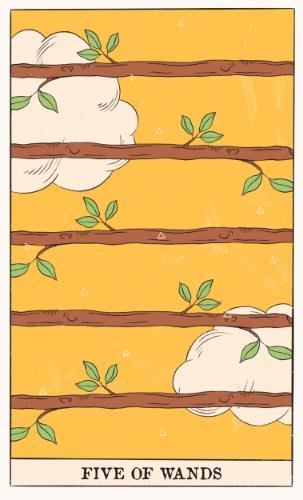
Five of Wands
Keywords
Upright Meaning
The Five of Wands signals a period of tension and discord where multiple parties are pursuing conflicting objectives. This card appears when you're experiencing disagreements, workplace competition, or interpersonal friction that creates a challenging dynamic. The conflict may stem from miscommunication, incompatible goals, or simply too many strong personalities trying to assert dominance simultaneously.
This card invites you to recognize that not all conflict is destructive—it can catalyze necessary change and growth. The tension present often reflects underlying issues that need addressing. Rather than avoiding confrontation, this card suggests engaging with the difficulty directly and honestly. You may need to clarify your position, listen to opposing viewpoints, or find creative compromises that honor multiple perspectives.
In the Five of Wands, the chaos can feel overwhelming, but it's typically temporary. This card indicates a transitional phase rather than a permanent state. Success comes through maintaining your composure, staying focused on your core values, and refusing to get drawn into unproductive power games. Consider whether some conflicts deserve your energy or if strategic disengagement might be wiser. The appearance of this card often suggests that clear communication, mediation, or establishing firm boundaries will help resolve the tension and restore harmony.
Reversed Meaning
Reversed, the Five of Wands suggests resolution of conflict or avoidance of confrontation. This position indicates that tensions are dissipating, agreements are being reached, or harmony is being restored after a period of discord. You may be finding common ground with adversaries or discovering unexpected allies in your struggles.
However, the reversed position can also signal suppressed conflict—disagreements that remain unaddressed and fester beneath the surface. While outward peace has been achieved, underlying resentments or unresolved issues continue brewing. This position warns against false harmony achieved through avoidance rather than genuine resolution. Sweeping problems under the rug creates instability that may explode later with greater intensity.
The reversed Five of Wands can indicate surrender to circumstances you cannot control, acceptance of limitations, or choosing your battles wisely by declining to engage in unwinnable conflicts. This represents maturity and strategic thinking rather than weakness. You may be experiencing relief as a competitive situation concludes, or you're gaining perspective that certain conflicts aren't worth your energy.
In some contexts, this card suggests improved communication, reduced workplace tension, or healing in relationships. The key distinction lies in whether peace stems from genuine resolution and understanding or from avoidance and suppression of legitimate concerns. Examine whether apparent calm represents authentic progress or temporary truce.
Yes/No Meanings
In Love
Maybe—this card suggests relationship tension requiring honest dialogue before clear progress is possible.
In Career
No—conflict and competition indicate obstacles to your goals, though resolution remains achievable through skillful navigation.
In Finances
No—competing claims on resources or disputed agreements suggest financial complications requiring mediation.
In Spirituality
Maybe—internal conflict between different aspects of yourself or spiritual paths demands integration for growth.
Symbolism
The Five of Wands traditionally depicts five figures wielding wooden staffs in a seemingly chaotic arrangement, each appearing to push against the others in different directions. This imagery represents competing wills and divergent goals clashing simultaneously. The wands themselves symbolize creative energy, passion, and willpower—suggesting that the conflict arises not from malice but from passionate individuals with strong convictions pursuing incompatible objectives.
The composition shows no clear winner or hierarchy; everyone appears equally empowered yet equally obstructed. This reflects how many conflicts lack obvious resolution because parties possess comparable strength. The tangled arrangement of wands suggests complexity and confusion—the difficulty of seeing clearly when multiple perspectives demand attention simultaneously.
The number five in numerology relates to change, challenge, and dynamic transformation. Combined with the Wands suit's association with action, ambition, and intellectual conflict, the Five of Wands emphasizes active confrontation rather than passive discord. The card's energy is volatile and demanding, refusing to be ignored or minimized. The visible struggle indicates that resolution requires direct engagement rather than wishful thinking or avoidance.
Practical Advice
When the Five of Wands appears, prioritize clear communication and active listening. State your position firmly but remain open to understanding opposing viewpoints. Identify which conflicts deserve your energy and which you can strategically ignore. Seek mediation or neutral third-party perspectives if direct dialogue becomes unproductive. Document disagreements professionally if workplace conflicts arise. Maintain emotional equilibrium by not taking opposition personally—disagreement doesn't equal rejection. Consider whether compromise solutions exist that partially satisfy multiple parties. Set firm boundaries to protect your interests while remaining respectful. Remember that temporary tension often precedes positive resolution when handled maturely.
Example Scenarios
Scenario 1
Workplace conflict: You're interviewing for a promotion alongside three equally qualified colleagues. The competition feels tense and personal, with subtle jabs during team meetings. The Five of Wands signals this competitive phase will pass—focus on demonstrating your value objectively rather than diminishing others.
Scenario 2
Relationship tension: Your partner disagrees fundamentally about life direction while you clash on daily decisions. The Five of Wands indicates you're in an active conflict phase requiring honest conversations about priorities, compromises, and non-negotiables. Avoidance won't resolve this.
Scenario 3
Creative collaboration: Group project with strong personalities yields constant debate about direction and approach. The Five of Wands suggests establishing clear decision-making protocols, respecting different viewpoints, and creating space for all voices rather than allowing one person to dominate discussions.