Eight of Swords
Keywords
Upright Meaning
The Eight of Swords in upright position speaks to a sense of entrapment and restriction, though with a critical caveat: the imprisonment is largely mental rather than absolute. You may feel caught between competing obligations, trapped by others' expectations, or constrained by self-doubt and limiting beliefs. This card often appears when anxiety, fear, or confusion clouds your judgment, making solutions seem impossible when they may actually be within reach.
The figure's blindfold is particularly significant—it suggests that perception itself is the primary obstacle. You might be overlooking available options because worry or negative self-talk dominates your mental landscape. The eight swords forming a cage represent multiple constraints: financial limitations, relationship dynamics, work pressures, or internalized shame that collectively create feelings of powerlessness.
This card is fundamentally about recognizing that many of your constraints are temporary and negotiable. While circumstances may genuinely be challenging, your response to them matters enormously. The Eight of Swords calls for honest assessment: which restrictions are real, and which are mental constructs you've accepted without question?
In readings, this card often appears during periods of high stress, decision paralysis, or when you're caught in circular negative thinking. It's a wake-up call to examine your assumptions about what's possible. The card suggests that you have more agency than you currently recognize, even if progress requires discomfort, difficult conversations, or reassessing previously held beliefs about your capabilities and options.
Reversed Meaning
The Eight of Swords reversed indicates liberation, release, and the breaking of psychological chains that have constrained you. This reversal suggests you're beginning to see through illusions that previously trapped you, removing the blindfold and recognizing your actual agency and freedom. Solutions that seemed impossible now become visible, and you're ready to act on them despite lingering uncertainty.
This card reversed often marks a turning point where you stop accepting limitation as inevitable. You might be shedding others' expectations, releasing perfectionism, or finally addressing anxiety that has paralyzed decision-making. There's movement toward clarity, courage, and concrete action rather than remaining stuck in analysis or self-imposed restraint.
However, reversed doesn't automatically mean complete freedom. Sometimes this position indicates that you're working through liberation gradually—removing one constraint at a time or cautiously testing boundaries. You might be regaining confidence slowly or discovering that some limitations weren't as absolute as you believed.
In some contexts, the reversed Eight of Swords can suggest releasing responsibility prematurely or ignoring genuine constraints that do require attention. Use discernment to distinguish between necessary limits and self-imposed restrictions worth challenging.
This reversal carries empowering energy: you're reclaiming autonomy, trusting your judgment again, and taking decisive action toward your goals. It's the card of emerging from difficult periods, successful problem-solving, and recognizing that what once seemed impossible is actually achievable. Progress may be gradual, but momentum is clearly shifting toward freedom and possibility.
Yes/No Meanings
In Love
Maybe - This card suggests complications and communication barriers that require addressing before clarity emerges.
In Career
No - The Eight of Swords indicates feeling stuck or limited in career matters, suggesting this isn't the right timing for major forward movement.
In Finances
No - This card reflects financial constraints and limited resources, suggesting financial goals face genuine obstacles requiring strategic planning.
In Spirituality
Maybe - While indicating spiritual confusion or limiting beliefs about your path, it suggests growth is possible through perspective shifts.
Symbolism
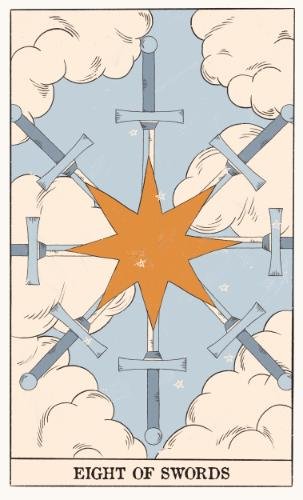
The Eight of Swords draws its power from careful visual composition. The central figure, typically bound and blindfolded, represents the querent trapped by circumstances—real or imagined. The blindfold is crucial symbolism: it blocks perception and possibility, suggesting that clarity is the first step toward freedom. The binding on the hands and feet indicates restriction of movement and action, reflecting how fear and limiting beliefs prevent forward progress.
The eight swords arranged around the figure create a cage-like structure, each blade representing different facets of entrapment: obligation, fear, self-doubt, external judgment, financial pressure, relationship dynamics, health concerns, or past trauma. Their sharp points emphasize danger and the painful nature of the situation, while their arranged formation suggests that escape routes exist if one looks carefully.
The background landscape often appears overcast or murky, symbolizing the mental fog and unclear thinking characteristic of this card's energy. Water or marsh-like terrain beneath the figure suggests emotional turbulence and the difficulty of solid footing.
The number eight itself carries significance in numerology—representing cycles, infinite possibility, and balance. Despite the card's apparent hopelessness, the eight swords paradoxically contain infinite potential for rearrangement and escape. This duality encapsulates the Eight of Swords' essential message: constraints are real but potentially temporary, requiring mental clarity rather than impossible physical feats.
Practical Advice
When the Eight of Swords appears, begin by objectively listing your constraints—which are genuinely immovable, and which are assumptions? Challenge the narrative you've constructed around your situation. Seek external perspectives from trusted friends or professionals; your current viewpoint is limited by anxiety or fear. Take one small action today that contradicts the limiting belief operating: make one phone call, research one option, or communicate one truth you've been avoiding. Write down three potential solutions you've been dismissing without serious consideration. Notice where perfectionism or others' expectations have shaped your beliefs about what's possible. Consider whether releasing the need to control outcomes might paradoxically increase your agency. Most importantly, recognize that feeling trapped often precedes breakthrough—this card's appearance can mark the moment before significant liberation becomes possible through incremental action and perspective shift.
Example Scenarios
Scenario 1
Career Scenario: Sarah feels trapped in an unfulfilling job, convinced she lacks the qualifications for better positions and that leaving would devastate her finances. The Eight of Swords reflects her mental imprisonment—the job market offers opportunities she hasn't explored, she has more savings than she acknowledges, and her skills are more valuable than imposter syndrome suggests. This card prompts her to research positions, consult a career counselor, and test her assumptions before accepting stagnation.
Scenario 2
Relationship Scenario: Marcus feels emotionally bound by his partner's needs, believing he must suppress his own desires to maintain the relationship. The Eight of Swords reveals that honest communication about his needs remains unexplored; he assumes conflict will be catastrophic without testing this belief. This card calls him to express himself authentically and discover whether the relationship can accommodate both partners' needs or whether leaving is necessary.
Scenario 3
Personal Growth Scenario: Jennifer believes her anxiety disorder permanently limits her potential for achievement, romance, and meaningful experiences. The Eight of Swords shows her psychological imprisonment—while anxiety is real, it doesn't eliminate possibility. This card encourages her to work with a therapist, challenge catastrophic thinking, and take small brave actions despite anxiety rather than waiting for perfect mental health before living.